Acoustic solutions for school dining halls
The school dining hall is one of the noisiest spaces in an educational facility. Within minutes, dozens or even hundreds of students may be talking, moving chairs, using cutlery and walking around the room, while staff organise meal sittings and supervise the service.
At Decustik, we develop acoustic solutions specifically for school dining halls, using engineered wood acoustic panels designed for high-traffic environments, integrated into the architecture and tailored to the specific needs of each school.
Common acoustic problems in dining halls
- Excessive reverberation: Hard surfaces cause sound to bounce off walls, floors and ceilings, creating a constant sense of noise.
- Communication difficulties: During peak hours, staff may struggle to give instructions, while students need to raise their voices to understand one another.
- Noise-related fatigue: Daily exposure to a very noisy environment can be exhausting for staff and may cause discomfort, restlessness or overstimulation in some students.
- Different acoustic conditions across the dining hall: Seating areas, entrances, self-service counters and spaces near the kitchen have different acoustic characteristics.
Benefits of acoustic treatment
A well-planned acoustic treatment can provide:
- Lower perceived noise levels during mealtimes.
- More natural conversations between students.
- Clearer instructions from staff.
- Reduced noise-related fatigue.
- A calmer, more organised environment.
- Greater comfort for students, supervisors and kitchen staff.
- A more comfortable environment for children who are sensitive to high noise levels.
The aim is not to make the dining hall silent, but to control reverberation so that daily activities can take place in a more pleasant environment.
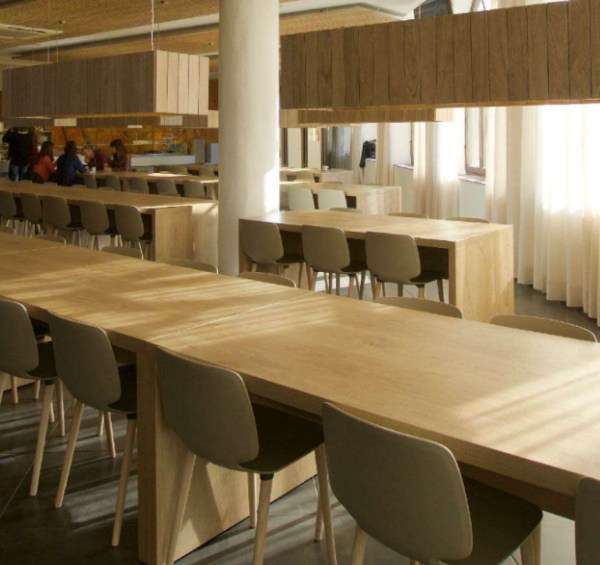
Where can acoustic solutions be installed?
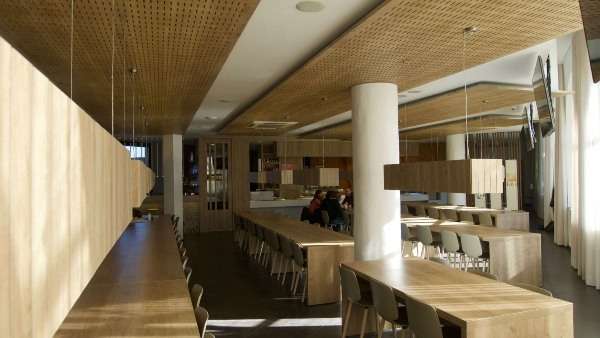
- Ceilings: Ceilings usually provide a large surface area for incorporating sound absorption without taking up usable space or obstructing movement. Acoustic treatment can be installed continuously or through individual elements distributed according to the room’s geometry.
- Walls: Wall-mounted acoustic panels help treat highly reflective surfaces and increase sound absorption in areas where students tend to gather.
- Areas near serving counters: These areas concentrate conversations, the movement of trays and the clatter of dishes and cutlery. Targeted acoustic treatment can reduce sound propagation towards the seating area.
- Large dining halls: In spacious rooms or those with high ceilings, combining horizontal and vertical acoustic treatments may be necessary to achieve more uniform acoustic performance.
Factors to consider before acoustic treatment
Every school dining hall has different characteristics. Before choosing a solution, it is important to assess:
- Room volume and geometry.
- Ceiling height.
- Typical number of students per meal sitting.
- Existing materials and surfaces.
- Layout of tables and circulation areas.
- Proximity to the kitchen.
- Existing reverberation time.
- Cleaning, durability and maintenance requirements.
- Integration with lighting, HVAC systems and other technical installations.
Based on this assessment, it is possible to determine which surfaces require treatment and how much sound absorption the space actually needs.
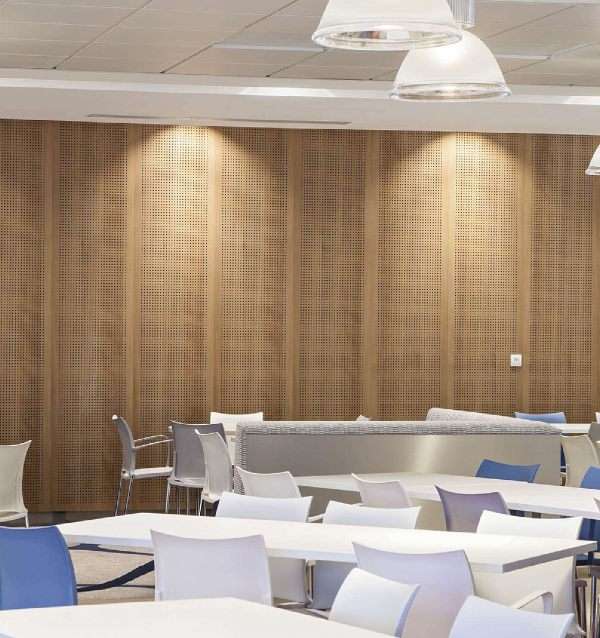
Acoustic panels for school dining halls
At Decustik, we design and manufacture engineered wood acoustic panels for educational facilities and shared spaces. Different acoustic solutions can be used in school dining halls:
- Perforated acoustic panels: suitable for treating walls and ceilings with effective sound absorption.
- Grooved acoustic panels: combine acoustic control with a linear design.
- Microperforated acoustic panels: offer discreet visual integration.
- Slatted acoustic systems: add warmth to the space and integrate naturally into interior design projects.
- Custom acoustic solutions: tailored to the dining hall’s geometry, installations and specific requirements.
Our systems can be customised in terms of dimensions, finishes and configurations to blend into the school’s design without making the dining hall look overly technical or visually cluttered.
- Categories
- Acoustics Spaces
- General Acoustics
Latest articles