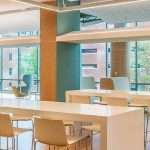

Acoustic treatment for town halls and public buildings
Acoustic comfort, intelligibility and functionality in institutional spaces
Town halls and public buildings are high-use spaces where citizen services, administrative activity, institutional meetings and public events coexist. In this type of building, acoustics plays an important role both in user comfort and in the proper day-to-day functioning of the spaces.
At decustik we collaborate on acoustic treatment projects for town halls, civic centres and public buildings, developing solutions based on technical wood acoustic panels adapted to the specific needs of each space and use.
The importance of acoustics in public buildings
In this type of facility, acoustics directly influences:
- The clarity of communication in public service areas.
- The acoustic comfort of staff and visitors.
- The intelligibility in meeting rooms and council chambers.
- The perception of order and quality of the space.
- The functionality of multipurpose and administrative areas.

Many public buildings combine large lobbies, wide corridors and multifunctional rooms with reflective materials such as glass, stone or concrete, which can lead to high reverberation times and acoustically uncomfortable environments.
Common acoustic problems in town halls and public buildings
1. Reverberation in lobbies and service areas
Problem: Main entrances and reception areas often have large volumes and hard surfaces that encourage sound reflection and make conversations more difficult.
Solution: Install sound-absorbing acoustic panels on walls or ceilings, such as perforated, slotted or micro-perforated technical wood panels. These solutions help reduce reverberation time and improve overall acoustic comfort.
2. Difficulty with speech intelligibility in council chambers and meeting rooms
Problem: Sound reflections and excessive reverberation can affect speech clarity during meetings, council sessions or public presentations.
Solution: Apply acoustic treatment focused on the frequency range of the human voice, improving intelligibility without altering the architecture of the space.

3. Noise propagation in administrative areas
Problem: Corridors, open areas and waiting zones can generate constant noise that affects the concentration and comfort of staff and users.
Solution: Incorporate sound-absorbing surfaces on walls, ceilings and circulation areas to reduce sound energy and limit noise propagation between spaces.
4. Multipurpose spaces with different uses
Problem: Many public buildings include rooms used for conferences, cultural activities or community events, each with different acoustic needs.
Solution: Design balanced and versatile acoustic solutions using technical panels adapted to the volume and functionality of each room.
Benefits of acoustic treatment
A properly planned acoustic treatment can provide:
- Greater acoustic comfort for users and staff.
- Improved speech intelligibility during events and meetings.
- Reduced listening fatigue in busy spaces.
- More organised and balanced environments.
- A better perception of building quality and maintenance.
- Greater functionality in multipurpose rooms.

Applications in public buildings
- Lobbies and reception areas: Acoustic treatments on ceilings and walls to control reverberation in high-traffic spaces.
- Council chambers: Solutions designed to improve speech clarity and acoustic comfort during sessions and institutional events.
- Offices and administrative areas: Acoustic panels that help reduce ambient noise and improve concentration.
- Multipurpose rooms and civic centres: Acoustic treatment adapted to cultural activities, meetings and public events.
- Corridors and circulation areas: Side treatments that help reduce sound propagation between different areas of the building.
Decustik Solutions
At Decustik we design and manufacture technical wood acoustic panels adapted to institutional and administrative spaces, where durability, maintenance and architectural integration are essential factors.
Common solutions:
- Perforated panels → efficient absorption in rooms and common areas.
- Slotted panels → acoustic control with a linear aesthetic.
- Micro-perforated panels → visual discretion and good acoustic performance.
- Slatted systems → architectural integration with balanced absorption.
- Custom solutions → adaptation to specific geometries and requirements.
All our systems are tested according to current acoustic standards and manufactured with high-quality technical wood, available on request with FSC or PEFC certifications.
If you are developing an acoustic treatment project for public buildings, our team can advise you from a technical and realistic perspective, adapted to the functional and architectural needs of the space.

- Categories
- Acoustics Spaces
- General Acoustics
Latest articles